
Topic 04 of 08
Measurement & Attribution
Proving which marketing dollars sold cars, and cutting the ones that didn't.
Why It Matters Now
Measurement means tying marketing spend to cars sold and repair orders written, not to clicks or leads alone. Franchised dealers spent a record $9.96 billion on advertising in 2025, most of it on digital channels, and each vendor reports results its own way, so the same buyer can be credited more than once. Without a shared yardstick, budget decisions default to whoever sends the most convincing monthly report.
The questions dealers ask are blunt. Which vendor actually sold the car? Is last-click misleading us? Can TV be measured now? What should a sale cost? The answers rest on a few habits: match sold deals in the DMS back to marketing, test big channels with holdouts, own your analytics and ad accounts, and treat any single attribution report as one view rather than the final word.
- $9.96BFranchised dealers' total advertising spend in 2025, a record, most of it digitalNADA, NADA Data 2025: Annual Financial Profile of America's Franchised New-Car Dealerships, 2026
- 19%2025 car buyers who used AI sites or AI search overviews (25% of new-car buyers)Cox Automotive, 2025 Car Buyer Journey Study, 2026
- 8%Google visits ending in a click on a regular result when an AI summary appeared, versus 15% withoutPew Research Center, Google users are less likely to click on links when an AI summary appears, 2025
- 60-75%Brand and agency users who say advanced measurement falls short on rigor, timeliness or trustIAB, State of Data 2026 (announced with Project Eidos), 2026
What You May Hear on Stage
The ideas and changes 2027 sessions on Measurement & Attribution are likely to dig into.
- Judging Sources by Cars Sold
Dealers on industry forums in 2026 are ranking lead sources by cost per sold and shown appointments rather than lead volume. Expect vendors to be asked for deal-level proof, not lead counts.
- AI Answers Hide the First Touch
19% of 2025 buyers used AI sites or AI search overviews, and Google users click fewer links when an AI summary appears. Fewer website sessions no longer mean less demand, so measure leads and sales.
- Holdout Tests Check Vendor Credit
Even large advertisers doubt their attribution: 60-75% of advanced-measurement users told IAB it falls short. Pausing a channel or holding out a group is the plainest way to see what it really adds.
- Streaming TV Joins the Sales Report
Streaming now takes 49.0% of US TV viewing time, and streaming ads can be matched to households and then to DMS sales. Expect sharper questions about consent behind smart-TV viewing data after Texas sued five TV makers in December 2025.
Questions Dealers Are Asking
Asked on dealer forums, in search and on panels this year, answered plainly with the sources.
Questions about the event? See the FAQHow do we figure out which marketing dollars actually sold cars?
Start from sold deals, not leads. Each month, match DMS deals back to lead sources, tracked calls and ad exposure using a fixed lookback window, then divide each channel's spend by its matched sales. Buyers often touch several sources, so expect overlap and compare the total of vendor claims with your real unit count. Your CRM can also send closed sales back to GA4 and Google Ads when your forms capture a shared ID, so those tools learn from sales instead of form fills.
Sources: support.google.com, support.google.com
A vendor says its ads influenced a big share of our sales. How do we check that?
Ask what counts as influence (an impression, a click or a household on a matched list), the lookback window and the match method. A match shows that a buyer was exposed, not that the ad caused the sale, since many of those buyers were already in market. The cleaner test is a holdout: withhold ads from a comparable group, or pause the channel for a set period, then compare sales.
Sources: support.google.com, iab.com
Should we trust last-click or multi-touch attribution?
Use both and know each one's bias. Last click gives all credit to the final tracked step, which favors search and the last lead source, and a CRM usually records only where the lead came in. GA4 retired its first-click, linear, time-decay and position-based models in November 2023; data-driven attribution remains, with a 90-day default lookback for most key events. Neither proves cause, so check your biggest channels with holdout tests.
Sources: support.google.com, support.google.com
What should we set up in GA4 so the numbers mean something?
Mark real lead actions as key events: form submissions, calls, chats, credit applications and service bookings. Many dealer website providers follow the Automotive Standards Council's shared GA4 event names, which makes data comparable across vendors. Set event data retention to 14 months, the longest option for standard properties, and keep junk signals such as accidental click-to-calls from mobile apps out of the goals your ads optimize toward.
Sources: support.google.com, support.google.com, automotivestandardscouncil.com
Can streaming TV ads really be tied to car sales?
Partly. Streaming took 49.0% of US TV viewing time in July 2026, and streaming ads can be matched to households, usually by IP address, and then to sold deals in the DMS. That shows overlap between exposed homes and buyers, not that the ad caused the sale, so ask for an unexposed holdout group. Smart-TV viewing data is also under legal pressure: Texas sued five TV makers in December 2025 over how they capture what people watch.
Sources: nielsen.com, adexchanger.com, pcworld.com
What's a reasonable advertising cost per car sold?
NADA's 2025 figures give a benchmark: franchised dealers spent $739 on advertising per new vehicle sold, and an estimated $586,246 per dealership for the year. Use it as a sanity check, not a target, since brand, market and used-car volume move the number. For individual sources, track cost per sold and cost per shown appointment, so a weak source is not confused with weak lead handling.
Sources: nada.org, news.dealershipguy.com
Website traffic is down but sales are steady. Should we worry?
Not by itself. Shoppers now get answers before they click: 19% of 2025 buyers used AI sites or AI search overviews, and Pew found Google users clicked a regular result on 8% of visits with an AI summary versus 15% without one. Judge the site on leads, calls, appointments and matched sales rather than sessions, and watch whether searches for your dealership name hold up.
Sources: coxautoinc.com, pewresearch.org
What should a monthly vendor report include, and who should own the accounts?
Ask for spend, leads by type, matched sales with the method and lookback window stated, cost per sold, and a row-level export you can check against the DMS. Have search vendors report spend on your own dealership name separately, since many of those shoppers were already looking for you. Keep the dealership as owner of the Google Ads, Meta and GA4 accounts, with more than one admin, so the history stays when vendors change.
Sources: support.google.com, c-4analytics.com
On the Agenda
The 2027 agenda keeps its three-day shape and fills in through the spring. Here is what’s confirmed on Measurement & Attribution, and what this topic looked like at DMSC 2026.
At DMSC 2026
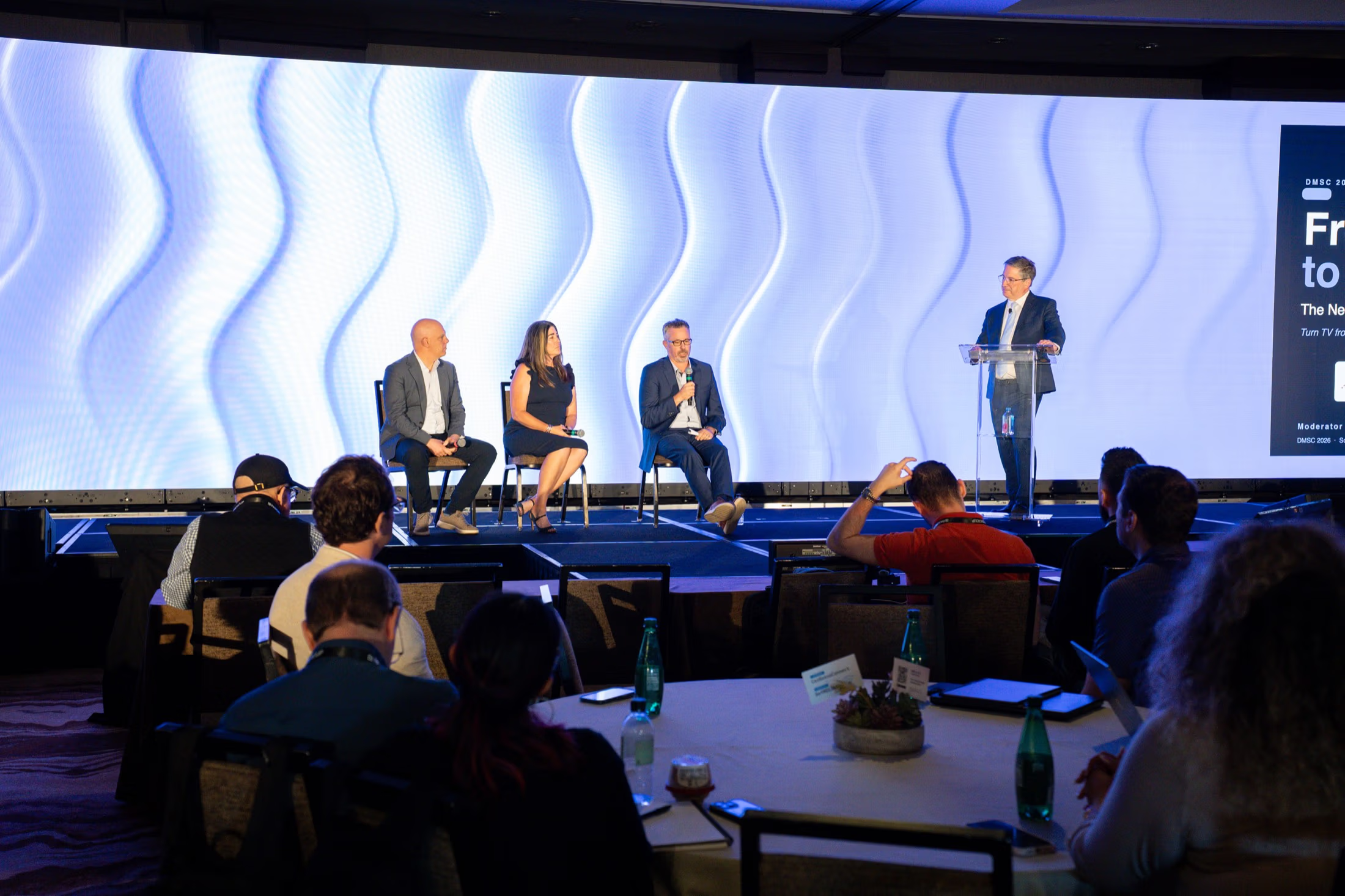
- From Living Room to Showroom: The New Science of TV AttributionTurn TV from a black box into a measurable performance channelTara Rego, Chris Kerr, Anthony Jingoli
- The State of the Industry: What 9,000 Rooftops Tell UsTurn data into consistent decisions that drive real dealership performanceBreAnna McCready
- Common Misbeliefs in Marketing StrategyReplace marketing myths with data-driven strategies that deliver real performanceHunter Allen
- Dealer Reality Check – What’s In, What’s Out in 2026What’s Actually Working, What’s Quietly Breaking, and What Dealers Need to Fix NowJoe High, Brennan McEachran
- From Data to Decisions: Aligning Metrics, Messaging, and Vendor AccountabilityLearn how dealerships turn confusing dashboards into accountable marketing performanceGlenn Pasch, Denise Galiatsatos, Patrick Abad and 2 more
People & Partners
The speakers who covered Measurement & Attribution at DMSC 2026, and the partners whose work sits in this space.
On Stage

Tara Rego
Director of Market Growth, Spectrum Reach

Chris Kerr
Chief Revenue Officer, Clarivoy

Anthony Jingoli
Sr. Director Automotive Strategy & Partnerships, Comcast Advertising

BreAnna McCready
Senior Vice President of Sales, StoneEagle

Hunter Allen
Head of Strategic Partnerships, Capital One Auto

Joe High
Chief Product Officer, Team Velocity

Brennan McEachran
Founder, Advisor, and Speaker, MGI

Denise Galiatsatos
President/COO, PCG Digital


Take It Back
to the Store.
Ask Your Vendor
When you claim a sale, what counts as your touch (an impression, a click or a lead), and what lookback window and match method do you use?
Will you send the row-level list of matched deals each month so we can check it against our DMS and other vendors' claims?
Will you run a holdout or pause test with us to measure the sales we would not have gotten without you?
Try This Monday
0 of 3 done
Terms Worth Knowing
- Last-click attribution
- A model that gives all credit for a lead or sale to the final tracked touch before it.
- Data-driven attribution
- GA4's model that splits credit across touchpoints based on patterns in your own conversion data.
- Sales matchback
- Matching sold deals in the DMS to the people or households your marketing reached, or who became leads, within a set time window.
- Incrementality
- The sales that happened only because of an ad, measured by comparing an exposed group with a similar group that was held out.
- Cost per sold
- Marketing spend divided by vehicles sold over the same period, ideally tracked for each source.
- Key event
- A GA4 action you mark as important, such as a lead form or click-to-call, which GA4 used to call a conversion.
Go Deeper
Research, tools and conversations from Pasch Group, and the reporting worth your time.
From Pasch Group
- ResearchDefining Key Events for Google Analytics 4Which ASC events to mark as GA4 key events so Google Ads optimizes toward real dealer outcomes.
- ResearchGA4 Configuration Checklist for Auto DealersA 14-step checklist to set up GA4 so website and vendor ASC events are counted correctly.
- ToolCost Per Sale CalculatorCompare cost per lead, close rate and cost per car sold across every ad source.
- ToolDealer Tech Stack Cost CalculatorTotal your monthly software, see cost per car retailed, and spot tools doing the same job.
- Buyer GuideHow to Choose an Identity Resolution PlatformRecognize more anonymous website visitors within consent rules, and prove the matches sold cars.
- Buyer GuideHow to Choose a Dealer Website ProviderFaster pages, fewer bolt-ons, cleaner tracking, and protecting data and search rankings when switching.
- ArticleThree Years of the ASC SpecificationHow the shared GA4 event spec changed dealer reporting, CDP data and Google Ads, and what remains.
- ArticleWhy Dealers Should Demand ASC StandardsWhy consistent GA4 event data across vendors matters, and which providers still hold out.
Further Reading
- Dealership Guy · 2026Dealer ad spend nears $10 billion as digital marketing dominatesNADA's 2025 ad spend by channel, with SEO, search ads, listing sites and social taking most dollars.
- Cox Automotive · 2026Cox Automotive Car Buyer Journey Study Finds Efficiency, Digital Tools and AI Drive Record Satisfaction19% of buyers used AI tools while shopping, a step most attribution reports cannot see.
- Pew Research Center · 2025Google users are less likely to click on links when an AI summary appears in the resultsUsers clicked a regular result on 8% of visits with an AI summary versus 15% without, so traffic alone misleads.
- IAB · 2026IAB Announces Project Eidos: A Comprehensive, Interdisciplinary Initiative to Fundamentally Modernize Ad MeasurementLarge advertisers say attribution, incrementality and mix models all fall short today.
- Nielsen · 2026TV Usage Kicks Usual Summer Slowdown, Fueled by World Cup and Streaming in Nielsen's July Gauge ReportsStreaming took 49.0% of US TV time in July 2026, moving more TV spend within reach of household-level measurement.
Bring Your Questions.
Three days in one room with the dealers solving them and the executives who build the tools.